
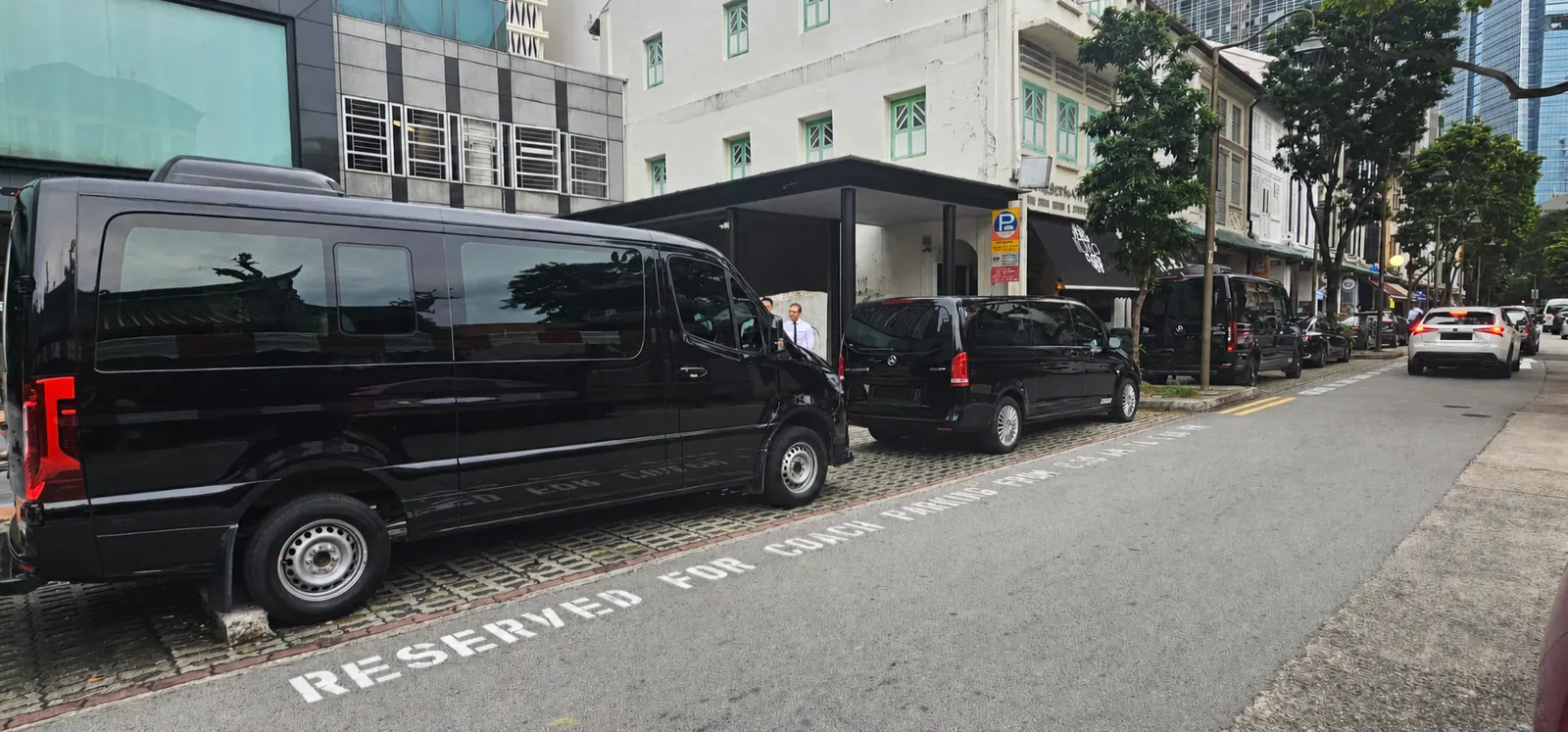
AirportTransferSingapore.com corporate transportation is ground transport bought by a company rather than by a passenger: booked by someone who is not travelling, billed to a cost centre rather than a card, and judged on whether it ran rather than on how it felt. Airport Transfer Singapore runs corporate work on account terms, with named drivers for repeat passengers, consolidated monthly invoicing, and a booking channel that does not require an app.
Most of the corporate book here is airport work and roadshow days for financial services, law and technology firms, plus standing arrangements for executives who travel the same route every week.
Corporate accounts at a glance
| Billing | Monthly consolidated invoice, credit terms on approval |
|---|---|
| Cost allocation | Cost centre, project code or matter number on every trip line |
| Booking channels | Email to operations, booking form, email for changes |
| Drivers | Named drivers assigned to repeat passengers |
| Rates | Fixed corporate rate card, agreed on account opening, no surge |
| Airport work | Flight tracked, meet-and-greet inside arrivals |
| Hourly work | 3-hour minimum, as-directed |
| Confidentiality | Drivers on corporate accounts sign a confidentiality undertaking |
| Reporting | Monthly trip report by passenger, cost centre and route |
| Coverage | Singapore island-wide, both airports, both cruise terminals, Johor Bahru |
What is a corporate transport service?
A corporate transport service is a standing supply arrangement between a company and a chauffeured operator, under which trips are booked against an account, priced from an agreed rate card and invoiced in arrears. The individual booking looks like any other Changi transfer or hourly chauffeur booking. What differs is everything around it: who is allowed to book, how the trip is coded, who receives the confirmation, and how the finance team sees it at month end.
The term overlaps with several others and buyers use them interchangeably. Executive transport usually means the same thing with an executive-class vehicle attached. Business chauffeur emphasises the driver. Corporate car service is the North American phrasing. Ground transportation management, which is what large multinationals put in a tender, describes a wider scope including reporting, duty of care and supplier consolidation. All of them start with an account.
What a corporate arrangement removes is reimbursement. When staff book their own rides, a company gets a stack of app receipts, no visibility of who travelled where, no way to tie a trip to a client matter, and no assurance that the vehicle was licensed and insured for a passenger who is travelling on company business. An account replaces all of that with one invoice, one supplier and one duty-of-care position.
How much does corporate transport cost in Singapore?
Corporate rates start at S$85 an hour for a Premium MPV and S$90 flat for a Changi arrival to the city, on a rate card fixed for the account term. Rates are all-in: tolls, ERP, parking, fuel, waiting inside the free window and GST.
| Vehicle | Capacity | Airport arrival | Airport departure | By the hour | 8 hours or more |
|---|---|---|---|---|---|
| Premium MPV | 5 seats, 3 passengers with 3 large cases | S$90 | S$80 | S$85 per hour | S$80 per hour |
| Executive MPV (Toyota Alphard, Vellfire or DENZA D9) | 6 seats, 4 passengers with 4 large cases | S$105 | S$95 | S$95 per hour | S$90 per hour |
| Business Van (Mercedes-Benz V-Class) | 7 seats, 6 passengers with 6 large cases | S$115 | S$105 | S$100 per hour | S$95 per hour |
| Minibus | 13 seats, 8 passengers with 8 large cases | S$130 | S$110 | S$110 per hour | S$100 per hour |
| 40-seater coach | 40 passengers, 35 large cases | S$220 | S$200 | S$180 per hour | S$170 per hour |
| Director arrival, Changi to a CBD hotel | Executive MPV | S$105 |
|---|---|---|
| Roadshow day, five meetings | Executive MPV, 6 hours | S$570 |
| Board offsite, two vehicles | Executive MPV x2, 8 hours | S$1,440 |
| Weekly standing airport run | Premium MPV, per movement | S$90 in, S$80 out |
| Client entertainment, evening standby | Executive MPV, 4 hours | S$380 |
| Site visit, Tuas and Jurong | Business Van, 10 hours | S$950 |
Volume terms are reviewed once an account is running regular monthly volume.
How a corporate account works
- Account opening. Company details, billing contact, authorised bookers and the cost-code structure you want on the invoice. One form, no deposit.
- Rate card agreement. Fixed rates by vehicle class for airport legs, hourly blocks and full days, held for the account term.
- Booking. Authorised bookers email operations or use the form. Confirmations go to the booker and, if you want, to the passenger separately.
- Travel. Driver name, mobile and plate go to the passenger the evening before. Flights are tracked without being asked.
- Invoicing. One monthly invoice, itemised by date, passenger, route and cost code, with a trip report alongside it.
Changes to authorised bookers, cost codes or passenger lists go through the same operations contact rather than a portal.
Who uses corporate accounts
Executive assistants and team assistants. The EA books, the director travels, and the EA is accountable for whether the car was there. Confirmations arrive by email with the flight number attached, changes go by email, and nobody has to install anything. The monthly invoice reconciles without chasing receipts.
Finance and procurement teams. The buying problem is visibility and duty of care: which staff travelled, in whose vehicle, under what insurance, coded to which project. A single supplier with LTA-licensed vehicles, PDVL drivers and a coded monthly invoice answers all four questions in one document.
Investment banks and law firms on transaction work. Roadshows and due diligence run to a schedule that changes hourly, across Raffles Place, Marina Bay Financial Centre and Suntec, often with confidentiality attached. Drivers on these accounts sign a confidentiality undertaking and are briefed on stops rather than told them on the day.
Technology and professional services firms with visiting teams. Regular inbound arrivals from the region, several people on the same flight, and a preference for one Business Van over three separate cars. Standing arrangements handle the repeat pattern.
Hotels, family offices and embassies. The booker is a concierge or a protocol officer, the passenger changes constantly, and discretion matters more than the rate. Vehicle standards and driver presentation are set once and applied to every job.
Companies relocating staff. Airport arrival, temporary housing viewings, school visits and the first month of commuting all sit under the same account, coded to the relocation budget rather than to travel.
Which vehicle for corporate work?
On corporate work the vehicle is a signal as well as a seat, and the wrong signal in either direction costs something.
| Vehicle | Seats | Best for |
|---|---|---|
| Premium MPV | 5 seats | Staff movements, internal travel, airport runs |
| Executive MPV | 6 seats | Client-facing, board level, roadshows |
| Business Van | 7 seats | Visiting teams, site visits, cost-effective for four or more |
| Minibus | 13 seats | Offsites, delegations, crew and event staff |
| 40-seater coach | 40 seats | Town halls, plant visits, full-team movements |
For four colleagues travelling together, one Executive MPV usually costs less than two Premium MPVs and gets everyone to the same door at the same time.
Account versus staff booking their own rides
| Cost visibility | Coded monthly invoice | Individual receipts to reconcile |
|---|---|---|
| Duty of care | Licensed operator, insured commercial cover, vetted drivers | Whichever driver accepted |
| Price stability | Fixed rate card | Surge exposure at exactly the busy times |
| Reporting | Monthly trip report by passenger and cost centre | Manual spreadsheet |
| Airport arrivals | Flight tracked, driver inside arrivals | Passenger queues at the pickup bay |
| Confidentiality | Undertaking signed by assigned drivers | None |
| Booking by a third party | Standard | Awkward, tied to the passenger’s app |
| Failure handling | Operations line, replacement vehicle dispatched | Rebook and hope |
Where an account loses: for one-off trips by staff who rarely travel, an app is simpler and probably cheaper. Accounts pay off on repetition, on airport work and on anything a booker has to answer for.
What to know before opening an account
What credit terms are available? Credit terms are set on approval. New accounts can start on prepayment and move to credit once the billing pattern is established.
Can the invoice be split by department? Yes. Every trip carries a cost centre, project code or matter number captured at booking, and the invoice groups by whichever field you choose.
Is there a minimum spend? No minimum to open. Volume terms are reviewed once an account is running regular monthly volume.
Can we restrict who books? Yes. Only named authorised bookers can charge to the account, and the list is changed by the billing contact.
What about duty of care and insurance? Every vehicle is LTA-licensed for private hire and carries commercial passenger insurance. Every driver holds a PDVL, which requires a medical and a background check. Certificates are provided at account opening for your records.
Do you sign NDAs? Yes, at company level, and drivers assigned to the account sign a confidentiality undertaking covering passenger identity, destinations and conversation.
Can passengers book directly against the account? Yes, if you authorise them individually. Most accounts keep booking with assistants and let passengers make changes only.
What reporting do we get? A monthly trip report by date, passenger, route, vehicle class and cost code, in a spreadsheet alongside the invoice.
Peak periods to plan around? Grand Prix weekend in September, the Singapore Airshow in February, Fintech Festival week in November, Chinese New Year, and the two weeks before Christmas. Standing bookings are protected in these windows; ad-hoc requests may not be.
Where corporate work runs
Financial and legal: Raffles Place, Marina Bay Financial Centre, One Raffles Quay, Shenton Way, Republic Plaza, Ocean Financial Centre, Marina One. Technology and research: one-north, Fusionopolis, Biopolis, Changi Business Park, Mapletree Business City, International Business Park. Industrial and site visits: Tuas, Jurong Island access points, Seletar Aerospace Park, Woodlands, Loyang. Meeting venues: Suntec Convention Centre, Sands Expo, Singapore Expo, Raffles Hotel, Fullerton, Capella Sentosa. Airports and terminals: Changi Terminals 1 to 4, Seletar Airport, and both cruise terminals for client sailings. Executive residential: Bukit Timah, Tanglin, Sentosa Cove, River Valley, Holland Village, Orchard. Regional: Johor Bahru and Iskandar via Woodlands or Tuas, for plant visits and cross-border meetings.
Mistakes companies make with ground transport
- Buying on rate alone. The cheapest hourly rate rarely includes waiting, tolls and parking, and the invoice arrives with three extra lines.
- Leaving airport arrivals to the passenger. A director in a pickup queue after a 13-hour flight is the most visible failure in the whole travel programme.
- Booking legs for a roadshow day. Hourly is cheaper from three stops and keeps one driver on the schedule.
- Not fixing cost codes at booking. Coding at month end from a route list is guesswork.
- Ignoring insurance and licensing. Staff travelling on company business in an unlicensed vehicle is a duty-of-care exposure, not a saving.
- Booking peak weeks late. During Grand Prix and Airshow weeks the fleet is committed well in advance across the whole island.
- Treating relocation trips as travel spend. Arrivals, viewings and school runs belong to the relocation budget and code differently.
- Letting every team book its own supplier. Three suppliers means three insurance positions and no volume discount.
Licensing, insurance and confidentiality
Vehicles are licensed by the Land Transport Authority as private hire cars and inspected annually for commercial use. Drivers hold the Private Hire Car Driver’s Vocational Licence, the PDVL, which requires a medical examination, a criminal record check and a licensing course. Commercial passenger insurance is carried and certificates are provided at account opening.
Corporate clients are concentrated in financial services, law, technology and hospitality. Drivers assigned to corporate accounts sign a confidentiality undertaking. The fleet runs five classes, from a Premium MPV to a 40-seater coach, and is shared with the chauffeur operation at MySingaporeDriver.
Corporate transport FAQ
How do we open a corporate account?
Send company details, a billing contact and the list of authorised bookers. Account setup takes two business days, with no deposit.
Do you offer credit terms?
Yes, on approval, with terms agreed at account opening.
Can we get one invoice for several departments?
Yes, itemised and grouped by cost centre, project or matter number.
Can we request the same driver each time?
Yes, where the schedule allows, and it is standard on standing arrangements.
Do you cover airport arrivals for visiting staff?
Yes, with flight tracking and meet-and-greet inside arrivals as standard on account work.
What happens if a vehicle breaks down or a driver is delayed?
Operations dispatches a replacement and calls the booker rather than the passenger. Wherever practical, the replacement leaves before you notice.
Do you provide vehicles for multi-day events?
Yes, as a block allocation. See events and group transport.
Are your rates fixed for the year?
The rate card is fixed for the account term, with no surge or peak-date pricing inside it.
Can staff pay personally and claim back?
They can, but it defeats the point. The account exists so that they do not have to.
Do you handle cross-border trips to Malaysia?
Yes, with a surcharge and notice for the vehicle permit.
Is there a booking portal?
Bookings go by email, the form or email. Most assistants prefer email because it leaves a thread.
What is the cancellation policy on account work?
Straightforward bookings should be cancelled at least 24 hours before pickup. Standing arrangements, event work and other account bookings follow the cancellation terms agreed for the account or stated in the quotation.